
Kohi Café de Especialidad
Valencia
Score: 5/10
We read more than 2,000 cafes in nine cities for Wi-Fi, laptop friendliness and opening hours. Canggu and Chiang Mai win on quality, Barcelona wins the evening, and Berlin is not what its reputation says.

Nearly every ranking of cities for remote work is built from cost of living, visa rules and a writer's impressions. None of them measure the thing you actually spend your day inside, which is the cafes.
So we measured it. Every venue in nine cities, read from its public reviews and its posted opening hours, scored for Wi-Fi, for whether the room suits a laptop, and for whether it is still open in the evening. That is more than 2,000 cafes, and the results do not match the reputations.
| City | Cafes read | Fast Wi-Fi | Laptop friendly | Open past 9pm |
|---|---|---|---|---|
| Berlin | 499 | 58%of 228 rated | 58%of 358 | 28%140 places |
| Barcelona | 434 | 63%of 281 rated | 60%of 248 | 57%249 places |
| Canggu | 377 | 78%of 251 rated | 76%of 280 | 61%229 places |
| Lisboa | 308 | 74%of 140 rated | 64%of 213 | 34%105 places |
| Chiang Mai | 286 | 81%of 180 rated | 75%of 208 | 24%68 places |
| Bangkok | 220 | 80%of 61 rated | 81%of 105 | 15%33 places |
| Madrid | 195 | 67%of 39 rated | 57%of 44 | 58%114 places |
| Porto | 189 | 82%of 33 rated | 79%of 48 | 49%93 places |
| Valencia | 188 | 77%of 30 rated | 75%of 40 | 45%84 places |
Canggu and Chiang Mai are in a different league on quality. Canggu rates its Wi-Fi fast in 196 of 251 rated venues and reads as laptop friendly in 212 of 280 judged; Chiang Mai is close behind. Both also carry the highest average venue scores in the catalogue, 3.88 and 3.73 out of five.
This is not a coincidence or a climate. It is what happens when enough of the local economy depends on people who work from cafes: the cafes compete on the things those people need, and the ones that do not compete close.
Barcelona owns the evening. 249 of its 434 cafes are still open at 9pm, the highest share of the European cities and one of the highest anywhere. Madrid is right behind at 114 of 195. If your working day is shifted late, whether by time zones or by preference, Spain is set up for you in a way northern Europe is not.
Berlin is the surprise, and not in a good way. It has the largest catalogue of the nine at 499 venues, and the lowest laptop-friendly share among the big ones: 208 of 358 judged. Its Wi-Fi ratings are the weakest of the large catalogues too.
Berlin's reputation as a remote work city is real and it is built on coworking spaces, not cafes. The cafes are excellent and many of them are simply not interested in being offices, which is a legitimate position for a cafe to take and worth knowing before you arrive.
Portugal is quietly good. Lisbon and Porto both run above 60% on laptop friendliness among judged venues, and Porto has 93 of its 189 cafes open past nine. Neither city gets written about for this.
Three honest limits, because a table like this invites more confidence than it has earned.
The denominators differ. Wi-Fi is rated on 1,243 venues and laptop friendliness judged on 1,544, out of a catalogue of more than 2,000, because these come from what reviewers chose to mention. We report each share against its own denominator rather than the full catalogue, which is why the columns do not add up to the same base.
Nine cities is not the world. There is no Mexico City here, no Tbilisi, no Buenos Aires, no Seoul. The absence of a city means we have not read it, not that it is bad.
Averages hide the thing you will actually use. A city with a mediocre average and forty superb cafes is better to live in than a city with a good average and none, and Berlin is exactly that city. The average is a starting point for choosing a neighbourhood, not a verdict on a place.
Pick the city for the reasons people normally pick cities, then use the data to pick the district, and plan the day around more than one room. Every city we cover is broken down by neighbourhood, because a 500-venue city is not a useful unit and a 130-venue district is.
If your day runs late, weight the evening column heavily. It is the constraint that bites hardest and the one people plan for least: arriving in Chiang Mai on European hours means discovering that 218 of its 286 cafes have shut by the time your afternoon starts.
If your day is full of calls, weight the Wi-Fi column and read what actually breaks a cafe connection first, because the fix is usually not a better cafe.
Each venue is read from its public reviews and its Google-listed opening hours. The judgements about Wi-Fi, noise, laptop friendliness and time limits come from what customers wrote, not from a visit and not from the venue's own description. Where reviewers said nothing on a dimension, the venue carries no judgement on it and is excluded from that column rather than counted as a negative.
Opening hours are parsed from the posted hours for each day, and a venue counts as open late if it is still serving at 9pm on at least one day of the week.
The numbers above are live: this table reads the catalogue when the page is built, so it moves as cities are added and venues are re-read.
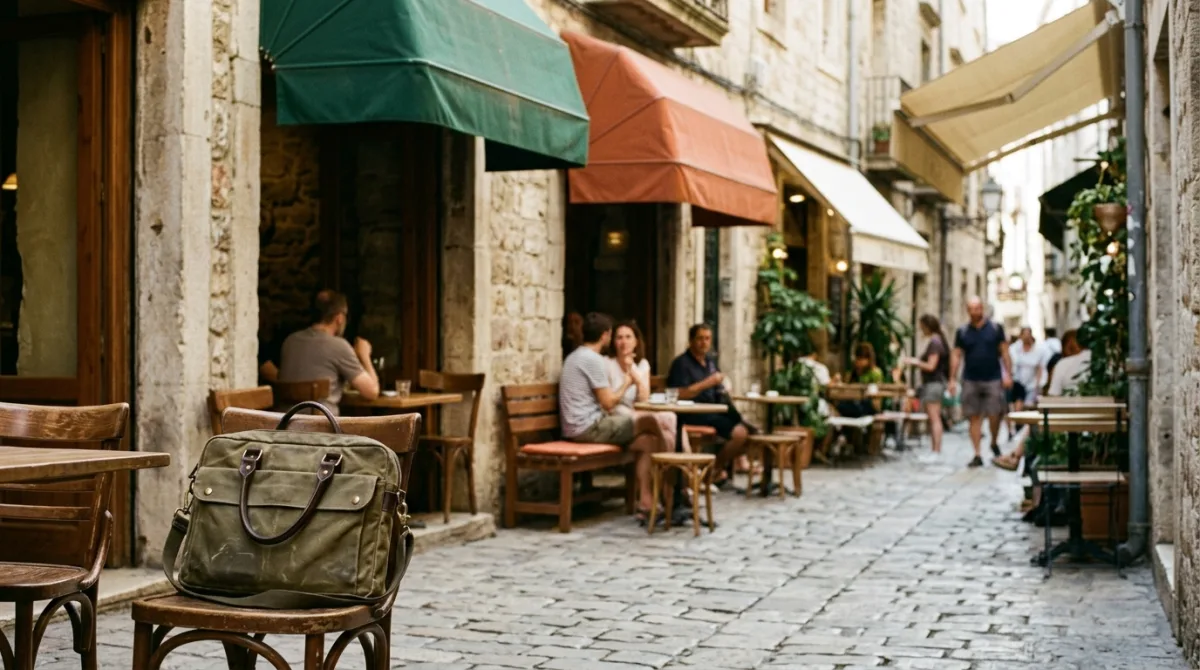
Three cafes in a day works better than one if you match the room to the task. Morning for deep work, afternoon for the shallow stuff, evening for whatever is left, and never more than a ten minute walk between them.

A video call needs about 4 Mbps. Almost every cafe has more than that, which is why blaming bandwidth for a dropped call is usually wrong. What breaks instead, and how to test a connection in thirty seconds.
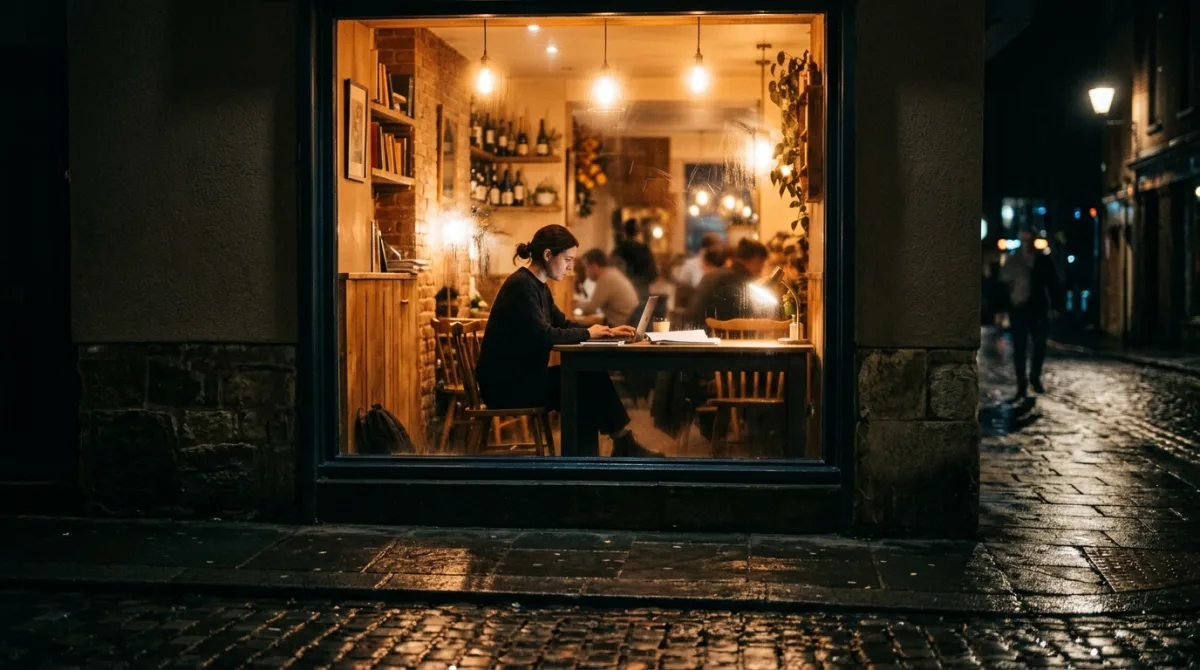
Four in ten cafes are still open at 9pm and one in seventy is open around the clock. Which cities keep working past dark, and how to find an evening table before you walk there.