
Kohi Café de Especialidad
Valencia
Score: 5/10
Three cafes in a day works better than one if you match the room to the task. Morning for deep work, afternoon for the shallow stuff, evening for whatever is left, and never more than a ten minute walk between them.

Working from three cafes in a day beats working from one, and not for the reason people usually give. It is not about novelty. It is that the hard work and the easy work want different rooms, and no single cafe is the right room for eight hours.
The version that fails is the one where you wander between places looking for a good one. The version that works is planned the night before and puts a specific kind of task in each stop.
First stop, from opening until about eleven. This is the deep work slot and it wants the quietest room you can find, which at that hour is almost any cafe: the morning rush is takeaway and it clears fast. Sit at the back, do the one thing that actually needs your brain, and do not open email.
Second stop, from about half past twelve. Move before the lunch rush, not during it, because arriving at one in a full room is how you end up at a bad table. This slot is for the shallow work: messages, admin, the reviewing and replying that fills most jobs. A busier room is fine and arguably better, because shallow work survives noise and benefits from the mild social pressure.
Third stop, from four onwards, and optional. The afternoon trough is the easiest time to get a good table anywhere. Use it for whatever the day left over, or for a call if you have found somewhere with a quiet corner.
Ten minutes' walk between stops, maximum. Beyond that the transition costs more than the change of room buys, and you will stop doing it by the third day.
This is why the planning is really about picking a district rather than picking cafes. Three good cafes within ten minutes of each other is a neighbourhood question, and it is exactly what the district pages are for: Eixample in Barcelona holds 131 of the city's cafes inside a walkable grid, and Friedrichshain-Kreuzberg holds 165 of Berlin's.
Pick the district first, then pick three inside it.
The plan lives or dies on the bag being light enough that moving is not a decision.
Laptop, charger, headphones, water. That is the list. Everything else is what makes people stay in one cafe all day because packing up feels like work.
A power bank replaces the charger on most days and removes the socket question from the first two stops entirely, which is worth more than it sounds: the socket is the single most common reason people end up at a bad table.
Ordering food at the first stop. It anchors you there for an extra hour and the hour is the wrong one, because the morning slot is your best thinking and you should leave while it is still good.
Moving because the room got bad rather than because the task changed. If you move reactively you will move four or five times and get nothing done. The schedule is the point.
Trying to take a call at the second stop. Half past twelve to two is the worst hour of the day in any cafe, for noise and for Wi-Fi. If a call is in the diary, it belongs in the third slot or outside.
Picking three cafes that are all the same. Three quiet minimal places is one room visited three times. The variety is the mechanism, so make the second one busier than the first.
The districts with enough density to do this without walking far are the ones worth starting in.

Sant Martí · 4.6 · 345

Sant Martí · 4.8 · 135

Sant Martí · 4.9 · 520

Sants-Montjuïc · 4.7 · 1221
Ciutat Vella · 4.9 · 418

Eixample · 4.7 · 1469
Read what makes a cafe laptop friendly before you build the route, since the first stop is the one that has to be right and the other two can be improvised.

A video call needs about 4 Mbps. Almost every cafe has more than that, which is why blaming bandwidth for a dropped call is usually wrong. What breaks instead, and how to test a connection in thirty seconds.
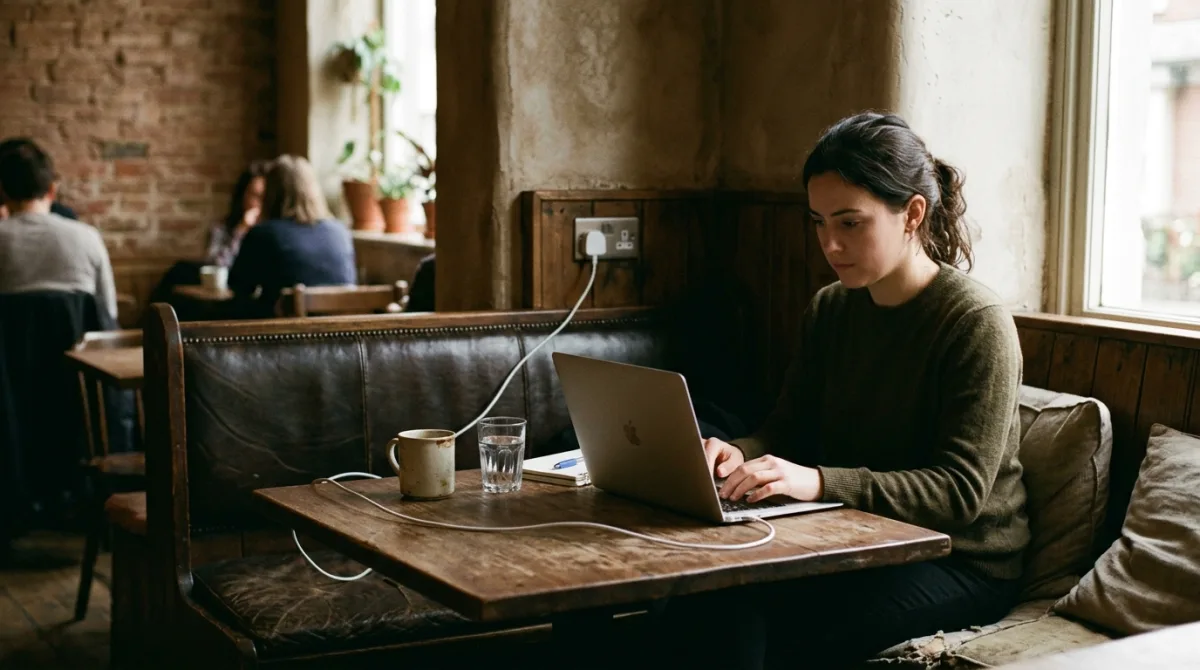
Sockets are the one thing cafe listings almost never record, including ours. Here is what we can and cannot tell you, and the reading tricks that work when the data does not exist.
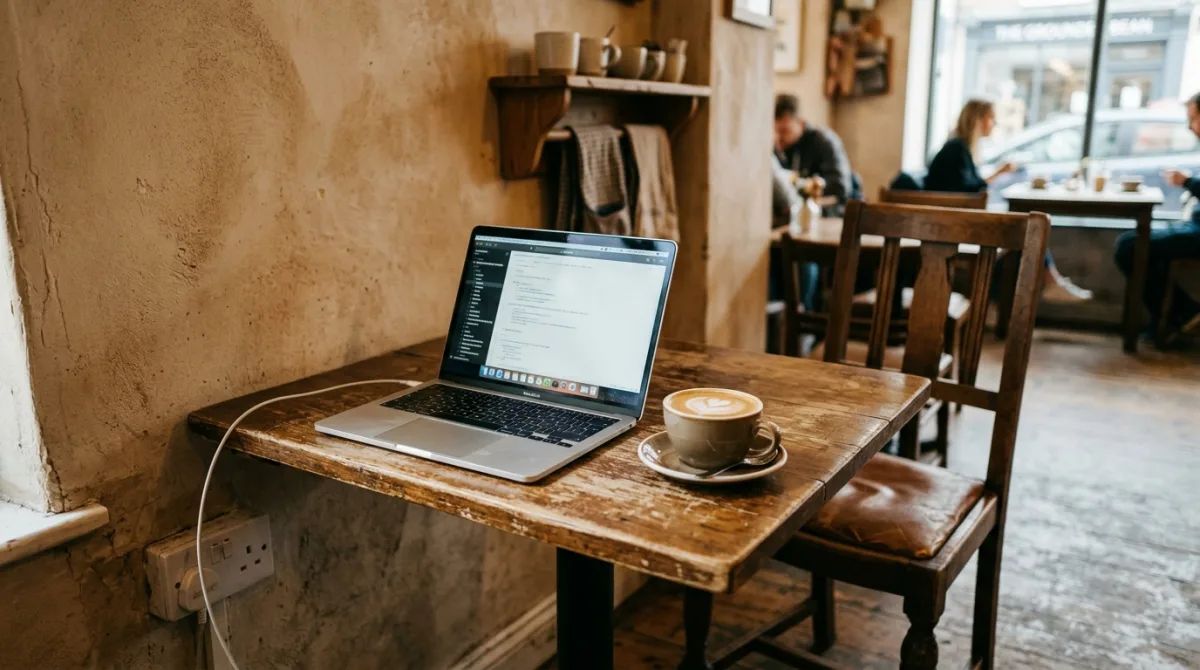
A laptop friendly cafe needs five things, and most places have three. What we found after reading more than 2,000 cafes across nine cities, and how to judge one before you sit down.