
Kohi Café de Especialidad
Valencia
Score: 5/10
Sockets are the one thing cafe listings almost never record, including ours. Here is what we can and cannot tell you, and the reading tricks that work when the data does not exist.

Sockets are the hardest fact to find about a cafe, and we should say plainly that our own data is thin here: across the whole catalogue we hold a judgement on power outlets for around a fifth of it. Reviewers simply do not mention them unless they are annoyed, which means the record everywhere skews toward complaints.
So this is not a list. It is what to do given that nobody, us included, has a reliable socket database.
The age and shape of the room predicts sockets better than any review does.
Converted spaces have them. A cafe in a former office, workshop or shop tends to have outlets along the walls at working height, because the previous tenant needed them. Exposed brick and visible conduit is a good sign for exactly this unromantic reason.
Purpose-built cafes often do not. A room designed as a cafe has power where the machines are, which is behind the counter, and decorative lighting everywhere else.
Look up at the lighting. Track lighting and pendant lamps on visible cable mean the electrics were run recently and cheaply, which usually means sockets came with them. Recessed ceiling spots in a plastered ceiling mean the opposite.
Big central tables are a tell. A single long shared table in the middle of a room almost always has a floor box under it, because you cannot run a table like that without one.
If you cannot see sockets, sit in this order.
Against a wall, in a corner, near the back. Corners collect outlets because that is where circuits terminate.
Next to a column or a structural pillar in an open room. Same reason.
Near the toilets or the corridor to them, which sounds unappealing and is the most reliably wired part of many cafes.
Avoid the window seats, which is counterintuitive because they are the seats everyone wants. Frontage is glass, and glass has no sockets behind it.
If you are going to ask, ask before you order, and ask about the seat rather than the building: "is there a socket near that table?" gets a useful answer, while "do you have power outlets?" gets a shrug in most languages.
Asking first also settles the other question you actually care about, which is whether they mind you working at all. A cafe that is happy to point you at a socket has just told you the answer.
The honest conclusion is that this problem is solved by equipment, not by research.
A power bank that can charge a laptop is under a hundred euros and removes the constraint entirely. Modern laptops charge over USB-C at 60W, and a 20,000mAh bank at 65W output will add most of a working day to a machine.
Failing that, arrive charged and turn the screen down. Display brightness is the single largest draw on a laptop, and going from full to half brightness typically buys an extra hour, which is often the whole gap you were worried about.
We do read every venue for the things reviewers do talk about: whether the Wi-Fi holds, whether the room is quiet, whether anyone minds a long stay, whether the tables suit a laptop. Those four are recorded across most of the catalogue, and they decide more sessions than sockets do. What laptop friendly actually means goes through all five conditions.
Charlottenburg-Wilmersdorf · 4.4 · 1227

Mitte · 4.5 · 871

Charlottenburg-Wilmersdorf · 4.6 · 1530
Mitte · 4.6 · 352

Mitte · 4.4 · 308

Mitte · 4.8 · 321
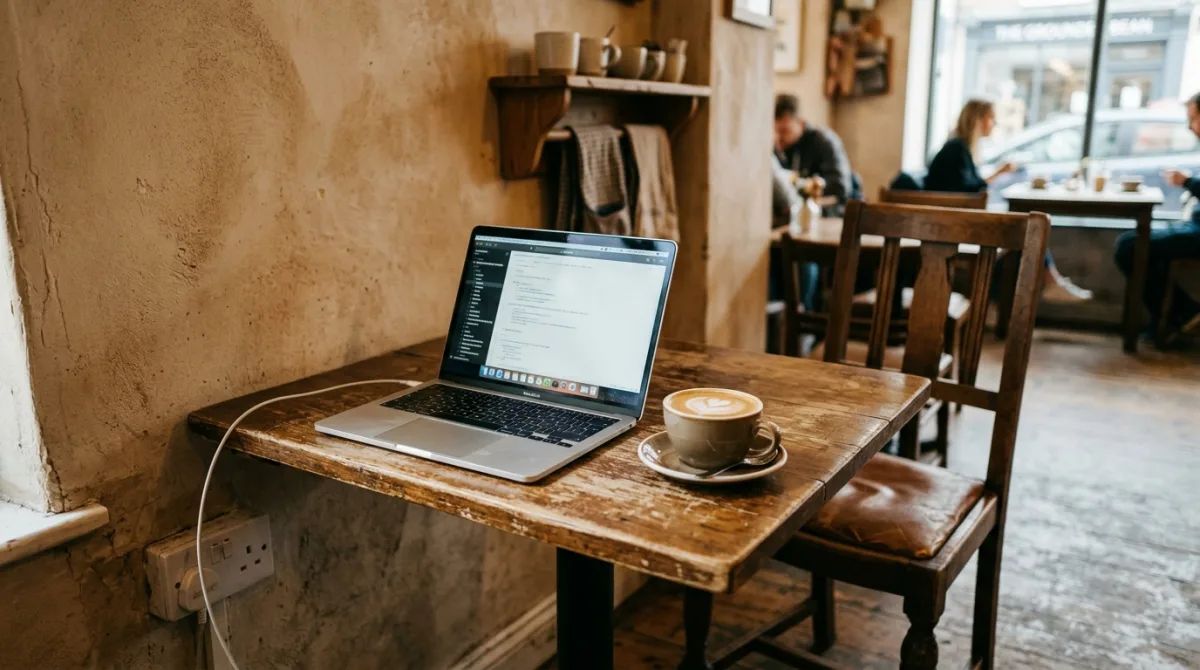
A laptop friendly cafe needs five things, and most places have three. What we found after reading more than 2,000 cafes across nine cities, and how to judge one before you sit down.
Three cafes in a day works better than one if you match the room to the task. Morning for deep work, afternoon for the shallow stuff, evening for whatever is left, and never more than a ten minute walk between them.
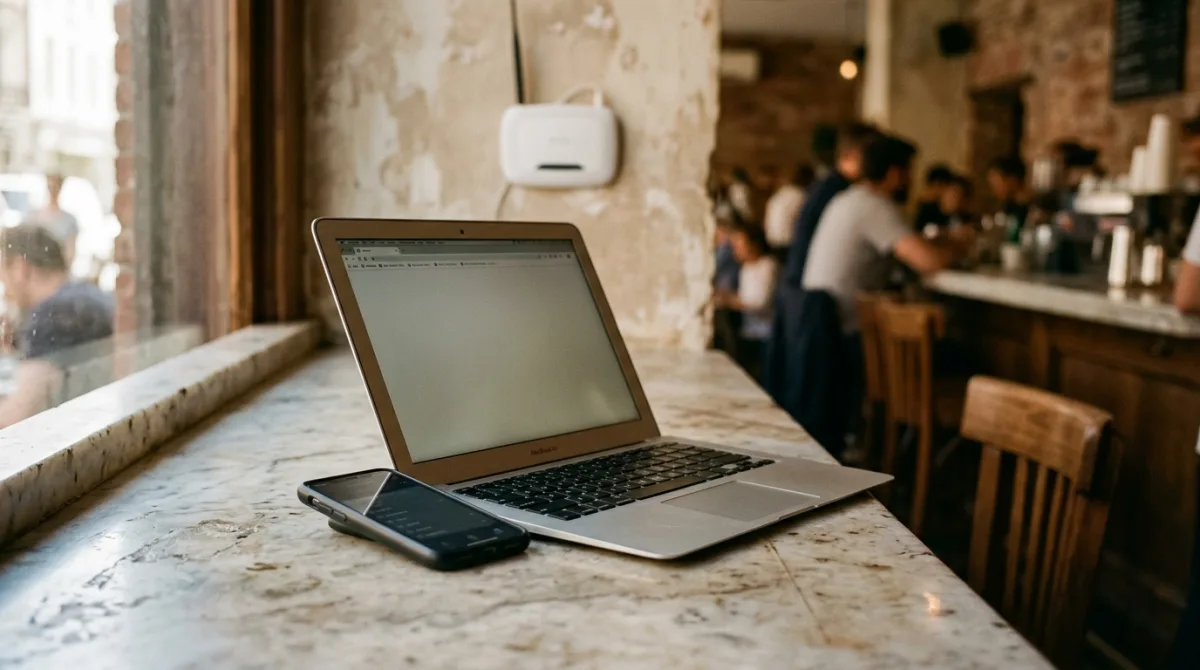
A video call needs about 4 Mbps. Almost every cafe has more than that, which is why blaming bandwidth for a dropped call is usually wrong. What breaks instead, and how to test a connection in thirty seconds.