
Kohi Café de Especialidad
Valencia
Score: 5/10
A laptop friendly cafe needs five things, and most places have three. What we found after reading more than 2,000 cafes across nine cities, and how to judge one before you sit down.

A laptop friendly cafe is one where you can open a laptop for two hours without anyone minding, on Wi-Fi that holds a video call, at a table the right height, within reach of a socket, at a noise level you can think through. Miss any one of those and the place is somewhere you drink coffee, not somewhere you work.
That distinction is not pedantry. We have read more than 2,000 cafes across nine cities from what their own reviewers wrote, and of the 1,544 where the reviews were clear enough to judge, 1,039 came out laptop friendly and 505 did not. Roughly a third of the places people walk into with a laptop are not set up for one.
2,703
cafes read
9
cities
Sitting down and finding out is the expensive way. In our reading, the five conditions fail in a fairly predictable order.
The welcome fails first. Not with a sign, usually, but with a room that has no table you could plausibly work at: bar stools, low lounge seating, a counter facing a wall. A cafe can be perfectly friendly and still have nowhere to put a laptop.
Then the sockets. This is the condition we can say least about, and we would rather say so than pretend: we hold a judgement on power outlets for only about a fifth of the catalogue, because most reviewers never mention them. When they do mention them it is almost always to complain.
Then noise. Not volume, pattern. A steady hum of conversation is easier to work through than a quiet room punctuated by a grinder every ninety seconds. Reviews are unusually good at capturing this, because it is what people notice, and it matters even more if you are studying rather than working.
Then Wi-Fi, which fails less often than its reputation suggests. Of the 1,243 venues where we hold a Wi-Fi rating, 879 rate four or five out of five. The problem is rarely that the Wi-Fi is bad; it is that it was fine at 9am and unusable at 1pm.
The time limit fails last, and it is the one that actually ends the session. Some places make it explicit at ninety minutes. Most do not say anything, and you feel it instead. We went into how long you can actually stay separately.
The share of laptop friendly places is not evenly spread, and the gap is bigger than any individual cafe review would suggest.
| City | Cafes read | Fast Wi-Fi | Laptop friendly | Open past 9pm |
|---|---|---|---|---|
| Berlin | 499 | 58%of 228 rated | 58%of 358 | 28%140 places |
| Barcelona | 434 | 63%of 281 rated | 60%of 248 | 57%249 places |
| Canggu | 377 | 78%of 251 rated | 76%of 280 | 61%229 places |
| Lisboa | 308 | 74%of 140 rated | 64%of 213 | 34%105 places |
| Chiang Mai | 286 | 81%of 180 rated | 75%of 208 | 24%68 places |
| Bangkok | 220 | 80%of 61 rated | 81%of 105 | 15%33 places |
| Madrid | 195 | 67%of 39 rated | 57%of 44 | 58%114 places |
| Porto | 189 | 82%of 33 rated | 79%of 48 | 49%93 places |
| Valencia | 188 | 77%of 30 rated | 75%of 40 | 45%84 places |
Two things stand out. Canggu and Chiang Mai run well ahead on both Wi-Fi and laptop friendliness, which is what happens when a local economy reorganises itself around people who work from cafes. Berlin sits lowest of the large catalogues at 58% laptop friendly, which surprises people, and should not: Berlin has an enormous number of excellent cafes that were built to be cafes.
Before you commit, three signals do most of the work.
Look at who is already there. One person on a laptop means nothing. Four means the staff have decided they are fine with it, which is the only permission that matters.
Look at the tables. Height first: a dining table works, a coffee table does not, and a bar counter is a forty minute seat rather than a three hour one. Then look at whether the tables have anything on them, because a place that lays a full setting is a place that wants to serve you lunch.
Look at the till, not the room. If there is a queue out the door at the exact hour you want to work, the room being pleasant is beside the point. You will be asked to move, politely, and you will be right to go.
Speed is not the number to check. Most cafe Wi-Fi is fast enough for anything short of uploading video, and 71% of the venues we hold a rating for are rated fast. What breaks is the shape of the connection under load.
A cafe router serving forty phones at lunchtime does not get slower in a smooth, honest way. It starts dropping packets, which a download shrugs off and a video call does not. This is why the Wi-Fi that felt perfect while you answered email falls apart the moment you join a standup.
If you have a call that matters, the practical answer is to test it before you need it and to have a phone with a tethering plan in your pocket. We wrote separately about how much speed a cafe actually needs.
The five conditions are not a checklist to run at the door. They are the reason a cafe that everyone recommends can still be wrong for you on a Tuesday afternoon with a deadline.
What we can do is take the guessing out of the first step. Every place in the catalogue has been read for these five things from what its own customers wrote, city by city and district by district.

Ciutat Vella · 4 · 88
Sant Martí · 4.3 · 2132
Sant Martí · 3.7 · 263

Ciutat Vella · 3.9 · 388

Sant Martí · 4.6 · 345
Sant Martí · 4.3 · 152
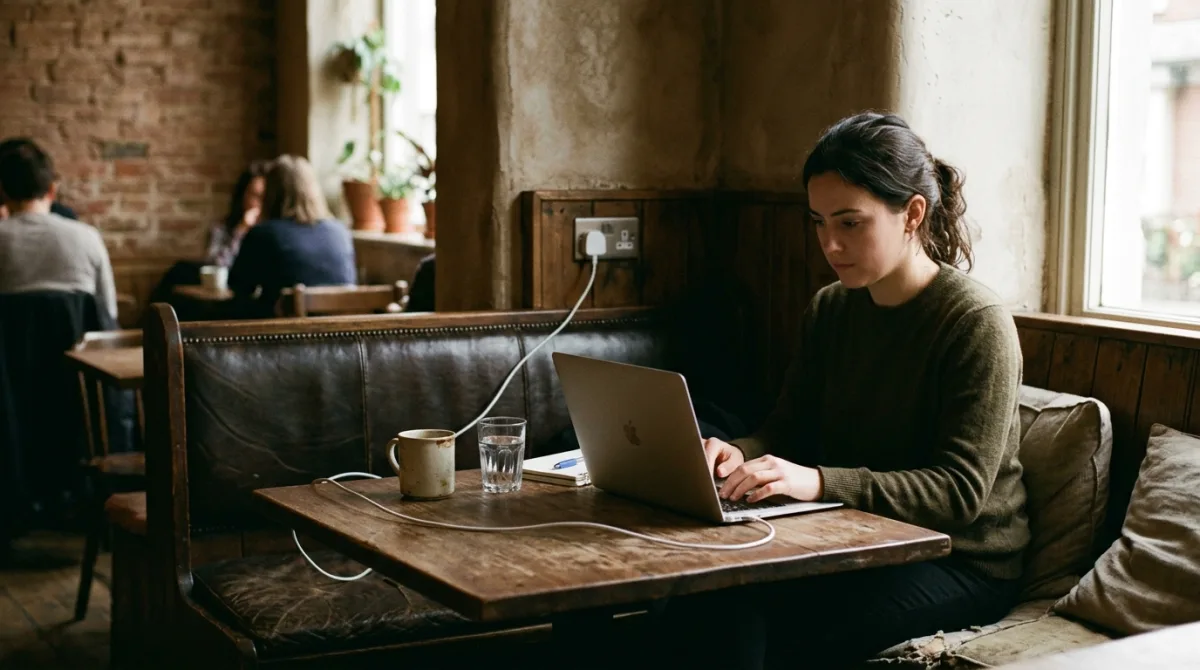
Sockets are the one thing cafe listings almost never record, including ours. Here is what we can and cannot tell you, and the reading tricks that work when the data does not exist.
Three cafes in a day works better than one if you match the room to the task. Morning for deep work, afternoon for the shallow stuff, evening for whatever is left, and never more than a ten minute walk between them.
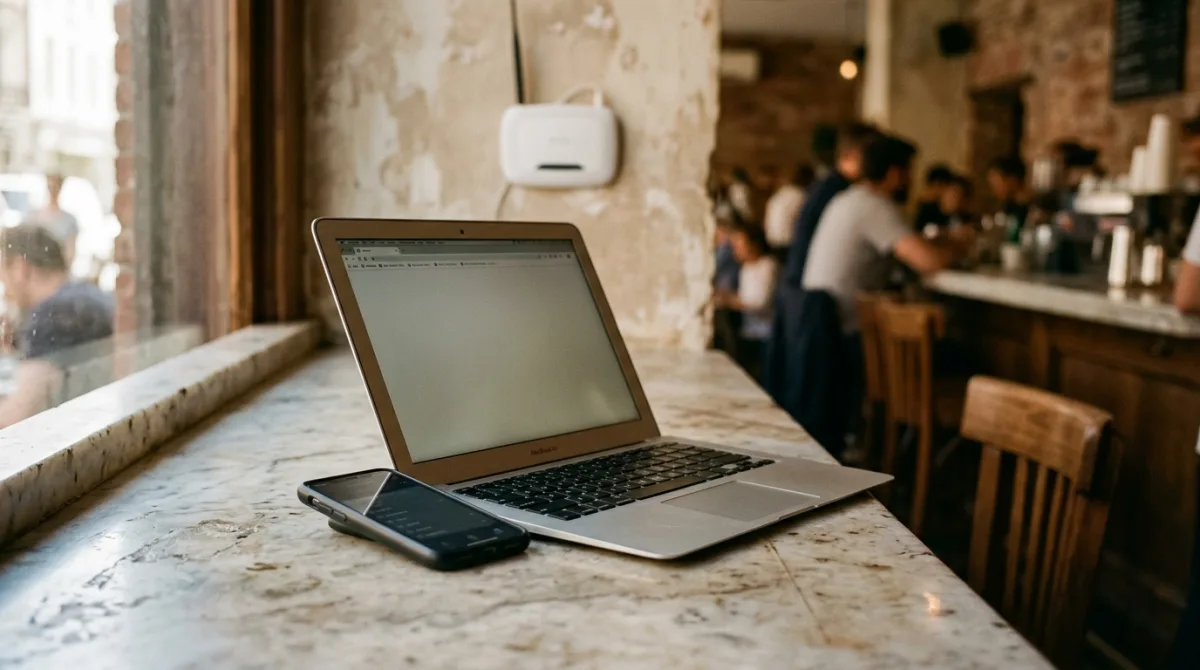
A video call needs about 4 Mbps. Almost every cafe has more than that, which is why blaming bandwidth for a dropped call is usually wrong. What breaks instead, and how to test a connection in thirty seconds.