
Kohi Café de Especialidad
Valencia
Score: 5/10
A cafe costs about two euros an hour in coffee and a coworking desk about two an hour in fees. The money is a wash, so the decision is about calls, storage and the days you cannot afford a bad room.

Run the arithmetic and the two options cost roughly the same. A cafe session at the going rate of an order every ninety minutes runs about 1.50 to 2.50 euros an hour in most European cities. A coworking day pass at 15 to 25 euros over an eight hour day is about the same, and a monthly hot desk at 120 to 200 euros over twenty days is cheaper per hour than either.
Which means money is not the deciding factor, and most comparisons that lead with money are answering the wrong question. Four other things decide it.
This is the real dividing line. If your day has more than about two calls in it, a cafe stops working, and not for etiquette reasons: you cannot reliably take a call in a room whose noise you do not control, and the alternative of stepping outside for each one turns a working day into a series of interruptions.
One or two scheduled calls is manageable in a cafe with headphones and a quiet corner. A day of back-to-back meetings is a coworking day, or a home day.
A coworking desk lets you leave a monitor, a keyboard and a jacket. A cafe means carrying everything, twice a day.
This sounds minor and it is the thing that most often decides it in practice, because it compounds. Carrying a laptop, charger, notebook and water bottle changes what else you can do with the day: no gym bag, no shopping on the way home, no bike.
The honest weakness of the cafe is variance. Most sessions are fine. Some are ruined by a table of six, a broken machine, or the one seat with a socket already being taken.
On a day with slack, that variance is free: you move, or you lose twenty minutes. Planned properly, moving is the point rather than the cost. On a day with a deadline at four, it is not, and paying fifteen euros to remove the variance is obviously worth it.
The rule that falls out of this: cafes for the days you can afford to lose an hour, coworking for the days you cannot.
Both solve loneliness, differently. A cafe gives you the presence of other people with none of the obligation to talk to them, which is exactly right for some people and not enough for others.
Coworking gives you people you will end up speaking to. Whether that is the point or the problem depends entirely on you, and it is worth being honest with yourself rather than aspirational: most people who buy a coworking membership for the community use it as a quiet desk.
Variety, which matters more than it sounds. Working from the same desk every day has the same problem as working from home, in a nicer room.
Coverage. There are more than 2,000 cafes in the nine cities we have read, and there are perhaps a few dozen coworking spaces in any of them. Whatever neighbourhood you are in, a workable cafe is a few minutes away.
| City | Cafes read | Fast Wi-Fi | Laptop friendly | Open past 9pm |
|---|---|---|---|---|
| Berlin | 499 | 58%of 228 rated | 58%of 358 | 28%140 places |
| Barcelona | 434 | 63%of 281 rated | 60%of 248 | 57%249 places |
| Canggu | 377 | 78%of 251 rated | 76%of 280 | 61%229 places |
| Lisboa | 308 | 74%of 140 rated | 64%of 213 | 34%105 places |
| Chiang Mai | 286 | 81%of 180 rated | 75%of 208 | 24%68 places |
| Bangkok | 220 | 80%of 61 rated | 81%of 105 | 15%33 places |
| Madrid | 195 | 67%of 39 rated | 57%of 44 | 58%114 places |
| Porto | 189 | 82%of 33 rated | 79%of 48 | 49%93 places |
| Valencia | 188 | 77%of 30 rated | 75%of 40 | 45%84 places |
And the ability to stop. A coworking day pass is a sunk cost that makes you stay until you have got your money's worth. A coffee is not.
A monthly coworking membership for the two or three days a week that have calls in them, and cafes for the rest. It costs less than five full days of either, and it puts the right day in the right room.
If you are not sure yet, start from the cafes: they are free to try, and a week of them will tell you exactly which days do not work.
Moncloa - Aravaca · 4.6 · 5879
Chamberí · 4.6 · 1760
Tetuán · 4 · 1932
Latina · 4.7 · 246
Chamberí · 4.6 · 1240
Moncloa - Aravaca · 4.8 · 816
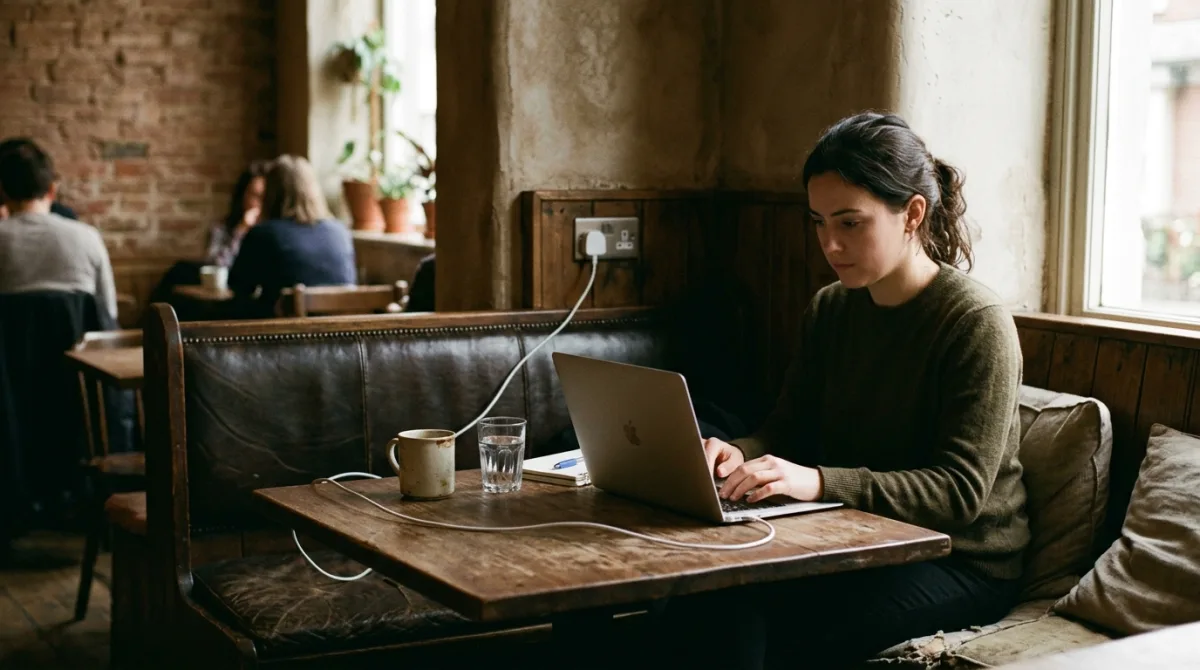
Sockets are the one thing cafe listings almost never record, including ours. Here is what we can and cannot tell you, and the reading tricks that work when the data does not exist.
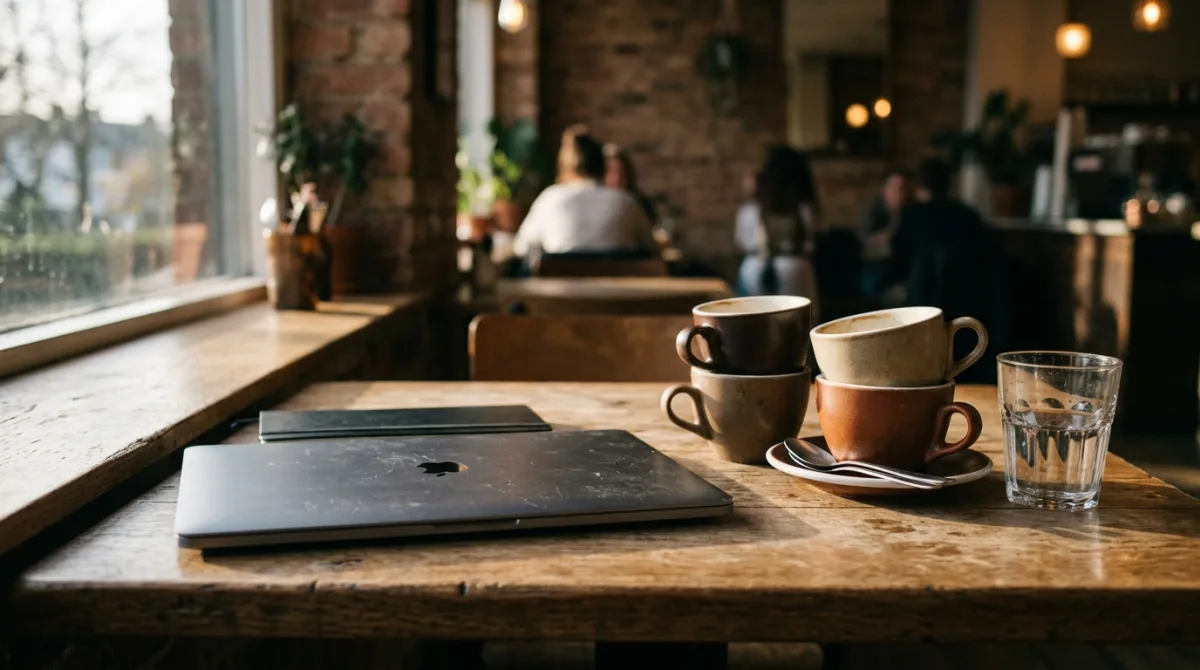
Two hours is safe almost anywhere, four is fine in most places if you keep ordering, and the limit is enforced by atmosphere rather than by rules. What actually decides it.
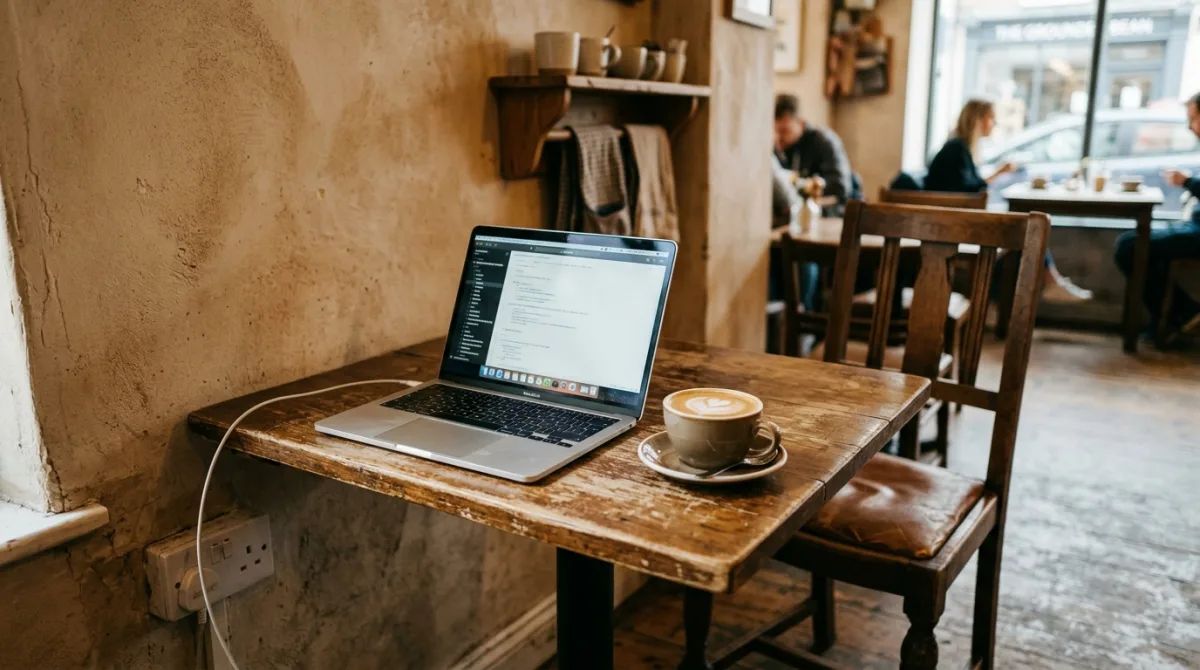
A laptop friendly cafe needs five things, and most places have three. What we found after reading more than 2,000 cafes across nine cities, and how to judge one before you sit down.