
Kohi Café de Especialidad
Valencia
Score: 5/10
Studying in a cafe asks different things of the room than working does: longer sessions, more table, less talking. What to look for, and why the cafe your colleague recommends is often wrong for revision.

A cafe you can study in needs a bigger table than one you can work in, tolerates a longer stay, and has to be quiet in a specific way: steady background noise is fine, sudden noise is not. Those three things rule out most of the places that top the "best cafes to work from" lists, and they are why students end up in libraries even when the library is worse in every other respect.
The gap is worth naming, because search does not distinguish. People looking for somewhere to revise and people looking for somewhere to answer email type nearly the same words and get the same lists.
The session is longer. Work in a cafe tends to run ninety minutes to two hours, often broken by a call. Revision runs three or four hours and is broken by nothing. A place that is generous about a two hour stay may not be generous about a four hour one, and the difference usually arrives as a hovering waiter rather than a conversation.
You need more surface. A laptop needs the space of a laptop. A textbook, a notebook, a laptop and a coffee need roughly a metre. This single physical fact eliminates most bar counters and every cafe that seats you at a 60cm two-top, which is a lot of them.
Silence is not the goal, predictability is. A room at a constant murmur disappears after ten minutes. A quiet room where a grinder fires every ninety seconds never does. Students consistently do better in the first, which is the opposite of what the word "quiet" suggests, and it is why a busy cafe can beat an empty one.
Go at the hour you will be there, not at a convenient hour. A cafe at 10am and the same cafe at 1pm are different rooms with different rules, and the lunch service is when a long stay becomes a problem.
Sit near a wall or a corner rather than in the middle. This is not about being antisocial; it is that a table with traffic on three sides is interrupted three times as often, and each interruption costs more when you are holding a chain of reasoning than when you are answering messages.
Ask about the closing time rather than reading it. Posted hours are when the door locks. The kitchen and often the coffee machine stop earlier, and the moment the machine stops is the moment staying starts to feel awkward.
Order in a way that buys time honestly. One coffee for four hours is the behaviour that makes cafes put up signs. Something every ninety minutes or so is the unwritten rate almost everywhere, and it is cheaper than a coworking day pass by a wide margin.
Two of the cities in our catalogue are unusually good for this, for the same reason: a large student population and a cafe culture built around staying.
| City | Cafes read | Fast Wi-Fi | Laptop friendly | Open past 9pm |
|---|---|---|---|---|
| Porto | 189 | 82%of 33 rated | 79%of 48 | 49%93 places |
| Chiang Mai | 286 | 81%of 180 rated | 75%of 208 | 24%68 places |
| Bangkok | 220 | 80%of 61 rated | 81%of 105 | 15%33 places |
| Canggu | 377 | 78%of 251 rated | 76%of 280 | 61%229 places |
| Valencia | 188 | 77%of 30 rated | 75%of 40 | 45%84 places |
| Lisboa | 308 | 74%of 140 rated | 64%of 213 | 34%105 places |
| Madrid | 195 | 67%of 39 rated | 57%of 44 | 58%114 places |
| Barcelona | 434 | 63%of 281 rated | 60%of 248 | 57%249 places |
| Berlin | 499 | 58%of 228 rated | 58%of 358 | 28%140 places |
Chiang Mai and Canggu run highest on both Wi-Fi and laptop friendliness, and they also have the cheapest coffee of the nine, which matters when a study session is four hours and three orders long. In Europe, Lisbon and Porto are the closest equivalents.
Most revision happens after the working day, and most cafes are built around the working day. Across the whole catalogue, more than 1,100 places are still open at 9pm, roughly four in ten, and only 38 are open around the clock.
That is a real constraint and it is worth planning around rather than discovering at 8:40pm. Each city has its own page of the places that stay open, so you can pick the evening spot in advance instead of walking, and the numbers behind that are worth a look if you study at night regularly.

Suthep · 4.9 · 43
ช้างเผือก · 4.8 · 1249

Phra Sing · 5 · 168
Suthep · 4.8 · 1165
Si Phum · 4.3 · 151

Suthep · 5 · 340
The idea that you need a special "study cafe" is mostly a marketing category. In Korea and Japan there are genuine study cafes, rented by the hour with assigned desks, and they are a different product. Everywhere else, a study cafe is just a cafe with a big table, a tolerant owner and predictable noise.
Which means you are not looking for a category. You are looking for a room, and the room is findable.
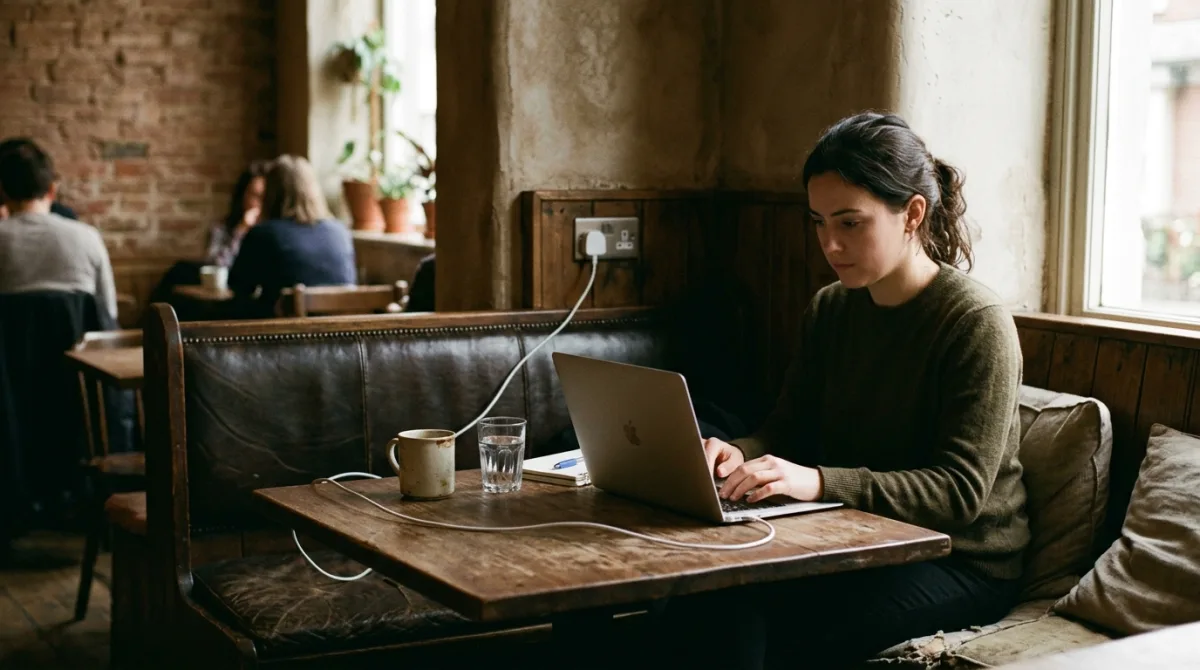
Sockets are the one thing cafe listings almost never record, including ours. Here is what we can and cannot tell you, and the reading tricks that work when the data does not exist.
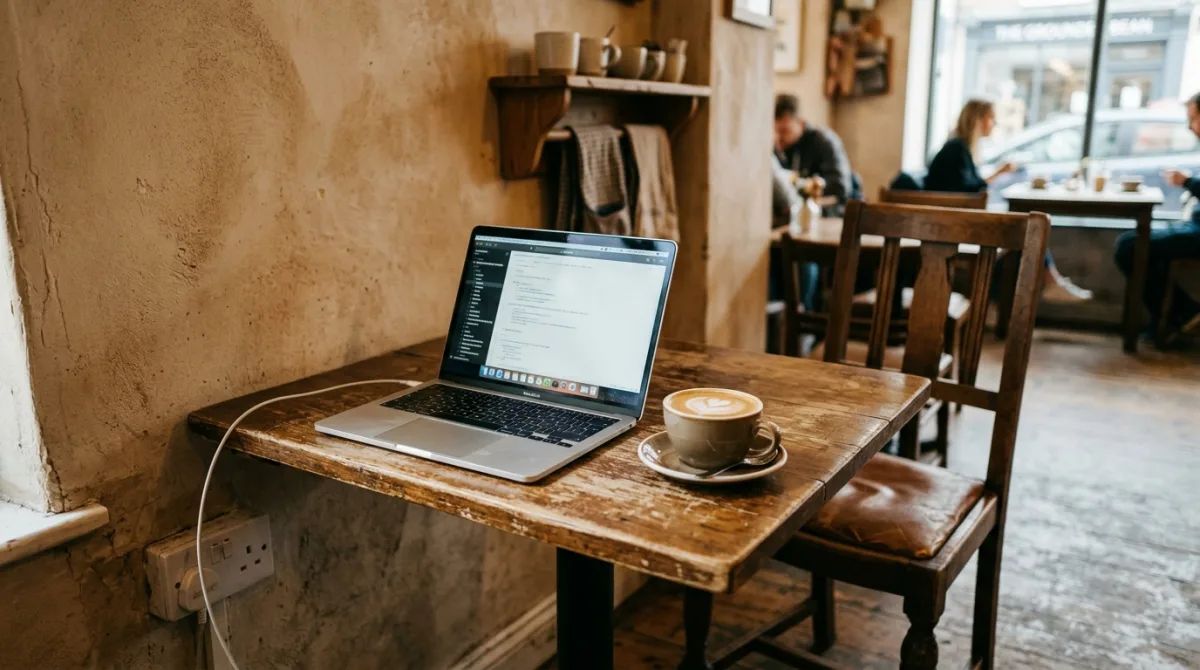
A laptop friendly cafe needs five things, and most places have three. What we found after reading more than 2,000 cafes across nine cities, and how to judge one before you sit down.
Three cafes in a day works better than one if you match the room to the task. Morning for deep work, afternoon for the shallow stuff, evening for whatever is left, and never more than a ten minute walk between them.